
The British pound and bond yields declined on Thursday, while the FTSE 100, Britain’s premier stock index, soared to a new high following the Bank of England’s inclination towards a rate decrease, supported by an additional policymaker.
The pound depreciated up to 0.4% against the dollar, reaching a two-week nadir of $1.2446, and was later trading at $1.2471. Against the euro, the pound was down slightly by 0.1%, at 86.04 pence.
On Thursday, the Bank of England’s Monetary Policy Committee decided by a 7-2 vote to maintain the interest rate at a 16-year peak of 5.25%, with Deputy Governor Dave Ramsden joining Swati Dhingra in advocating for a reduction to 5%.
Contrary to the majority of Reuters-polled economists’ expectations for an 8-1 vote to keep rates steady, the BoE’s move suggests a potential rate cut in the summer.
Market traders are currently estimating a 45% likelihood of a rate cut at the Bank of England’s next month’s meeting, with approximately 55 basis points of relaxation anticipated by the year’s end, hinting at two quarter-point reductions.
Governor Andrew Bailey indicated that future rate cuts might surpass market expectations, stating, “It’s probable that we will need to lower bank rates in the upcoming quarters, potentially making monetary policy less restrictive than what’s currently reflected in market rates.”
The markets have fully accounted for the initial quarter-point rate reduction by the August meeting, which is sooner than the Federal Reserve’s expected cut, not fully anticipated until November.
The first easing by the European Central Bank is projected by the money markets in June.
“The pound’s drop was an expected outcome,” remarked Jamie Dutta, a market analyst at Vantage Markets, highlighting the growing policy divergence with the Fed, with the Bank of England aligning more closely with the ECB.
Gilt prices increased, resulting in the benchmark 10-year gilt yield settling at 4.138%, showing minimal change for the day. Bond yields typically have an inverse relationship with their prices.
The yield on Britain’s two-year gilt, more reactive to rate change forecasts, decreased by 2.5 basis points to 4.288%.
The FTSE 100 index reached a new intraday record, climbing 0.4% to 8394.01 points.
“Signs of a cyclical upturn and the easing of European monetary policies bolster the prospects for the region’s equity markets, which have shown strong performance this year and continue to be attractively priced,” stated HSBC AM’s Mehdi.
Invest Finance

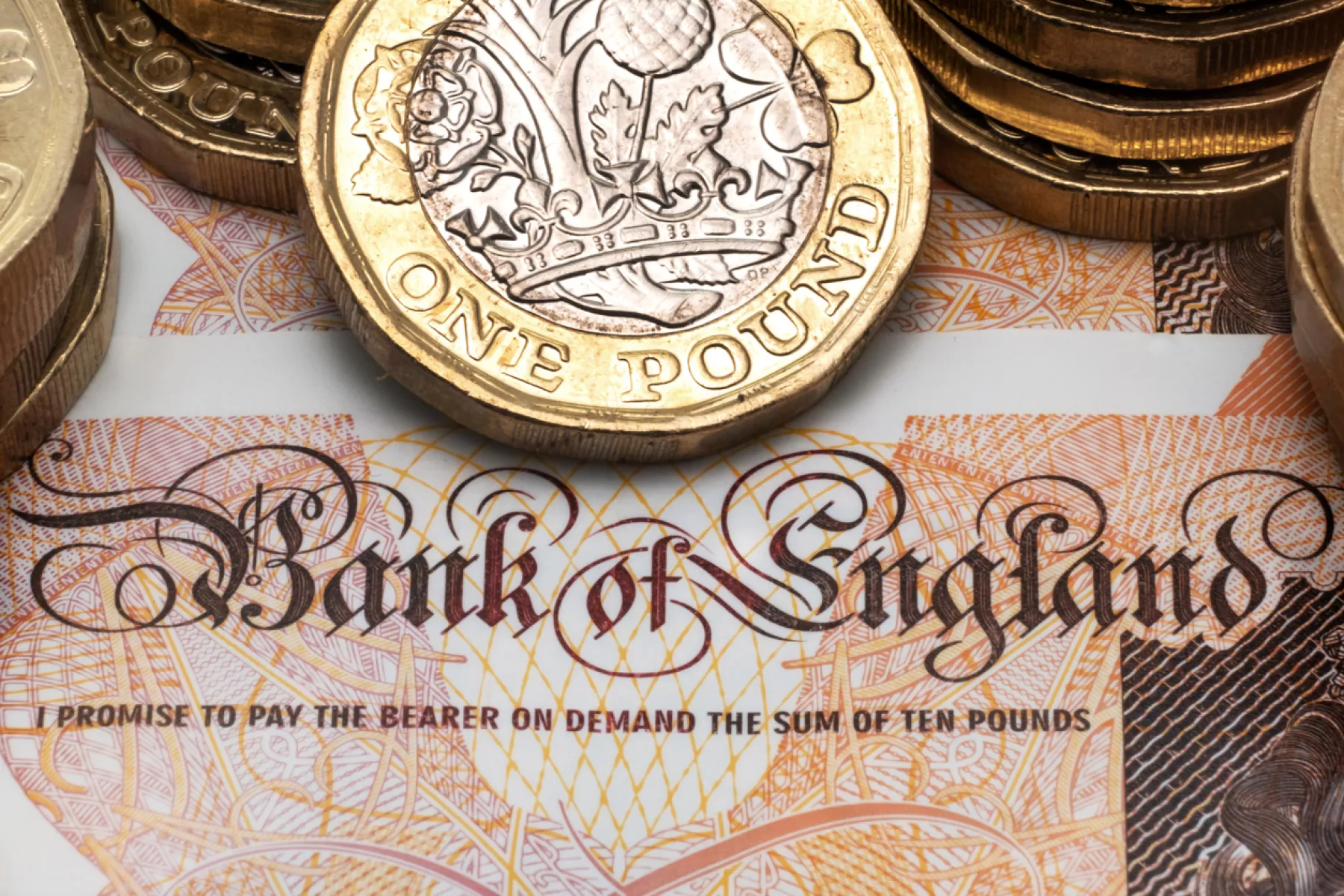
The pound weakens as the BoE signals a potential rate reduction, while the FTSE 100 leaps to an all-time high.
3 min